

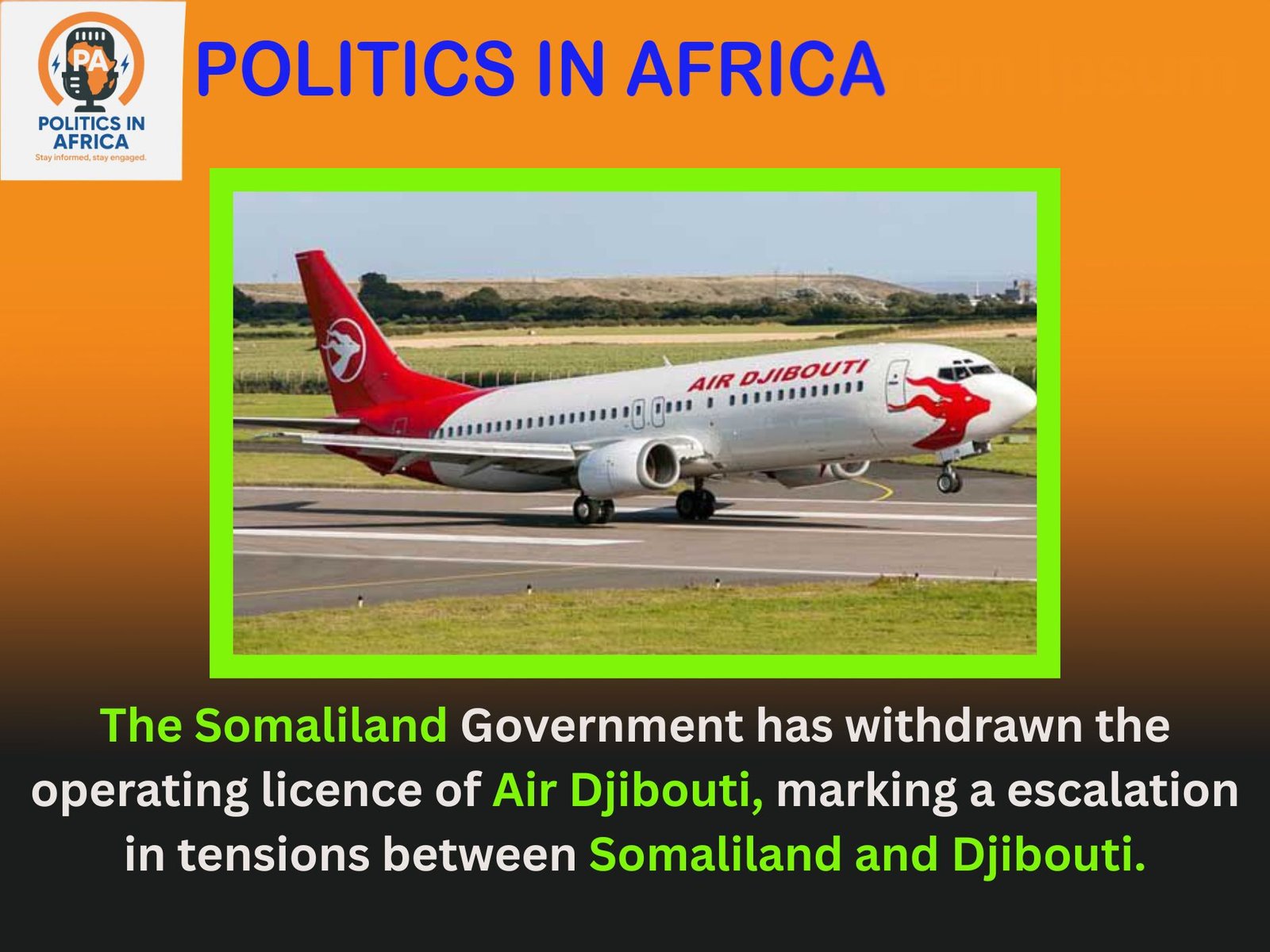
The Somaliland Government has officially withdrawn the operating licence of Air Djibouti, marking a significant escalation in diplomatic tensions between Somaliland and Djibouti.

The decision follows a sharp political fallout triggered by Israel’s recognition of Somaliland—an announcement that reshaped regional alignments and drew strong reactions across the Horn of Africa. Djibouti publicly rejected the move and aligned itself with Somalia, a stance that Somaliland officials view as openly hostile to its sovereignty and diplomatic standing.
Diplomatic relations at breaking point
According to diplomatic sources, relations between Hargeisa and Djibouti have deteriorated to their lowest level in years. Last week, both sides recalled their respective representatives and suspended formal diplomatic engagement, signaling a breakdown in dialogue and cooperation.
The withdrawal of Air Djibouti’s licence is widely seen as a retaliatory and strategic response, leveraging Somaliland’s control over its airspace and aviation regulations. Aviation analysts say the move underscores how air transport and access have become tools of political pressure in the region’s intensifying diplomatic disputes.
Regional implications
The escalation highlights broader geopolitical realignments following Israel’s recognition of Somaliland. While Somaliland has welcomed the decision as a milestone in its long-standing quest for international recognition, several regional states—particularly those closely aligned with Mogadishu—have moved quickly to oppose it.
Djibouti’s decision to side openly with Somalia reflects concerns over precedent-setting recognition and its potential impact on regional stability. Observers note that Djibouti hosts key foreign military bases and plays a pivotal role in Red Sea and Gulf of Aden security, making its diplomatic positioning especially influential.
Aviation and economic impact
The suspension of Air Djibouti’s operating rights may have immediate economic and logistical consequences, affecting passenger travel, cargo movement, and regional connectivity. Somaliland authorities argue that the decision is lawful and within their regulatory mandate, while critics warn it could further disrupt trade routes in an already fragile regional economy.
What comes next
There are currently no indications of mediation efforts or renewed talks between the two sides. Analysts warn that unless diplomatic channels are restored, the dispute could spill over into broader economic and security cooperation frameworks in the Horn of Africa.
For now, the licence withdrawal stands as one of the clearest signs yet that the political fallout from Somaliland’s recognition is reshaping alliances—and deepening divisions—across the region.
Politics in Africa will continue to monitor developments as the situation unfolds.
The Review
macOS Sierra
A wonderful serenity has taken possession of my entire soul, like these sweet mornings of spring which I enjoy with my whole heart. I am alone, and feel the charm of existence in this spot, which was created for the bliss of souls like mine.
PROS
- Good low light camera
- Water resistant
- Double the internal capacity
CONS
- Lacks clear upgrades
- Same design used for last three phones
- Battery life unimpressive