


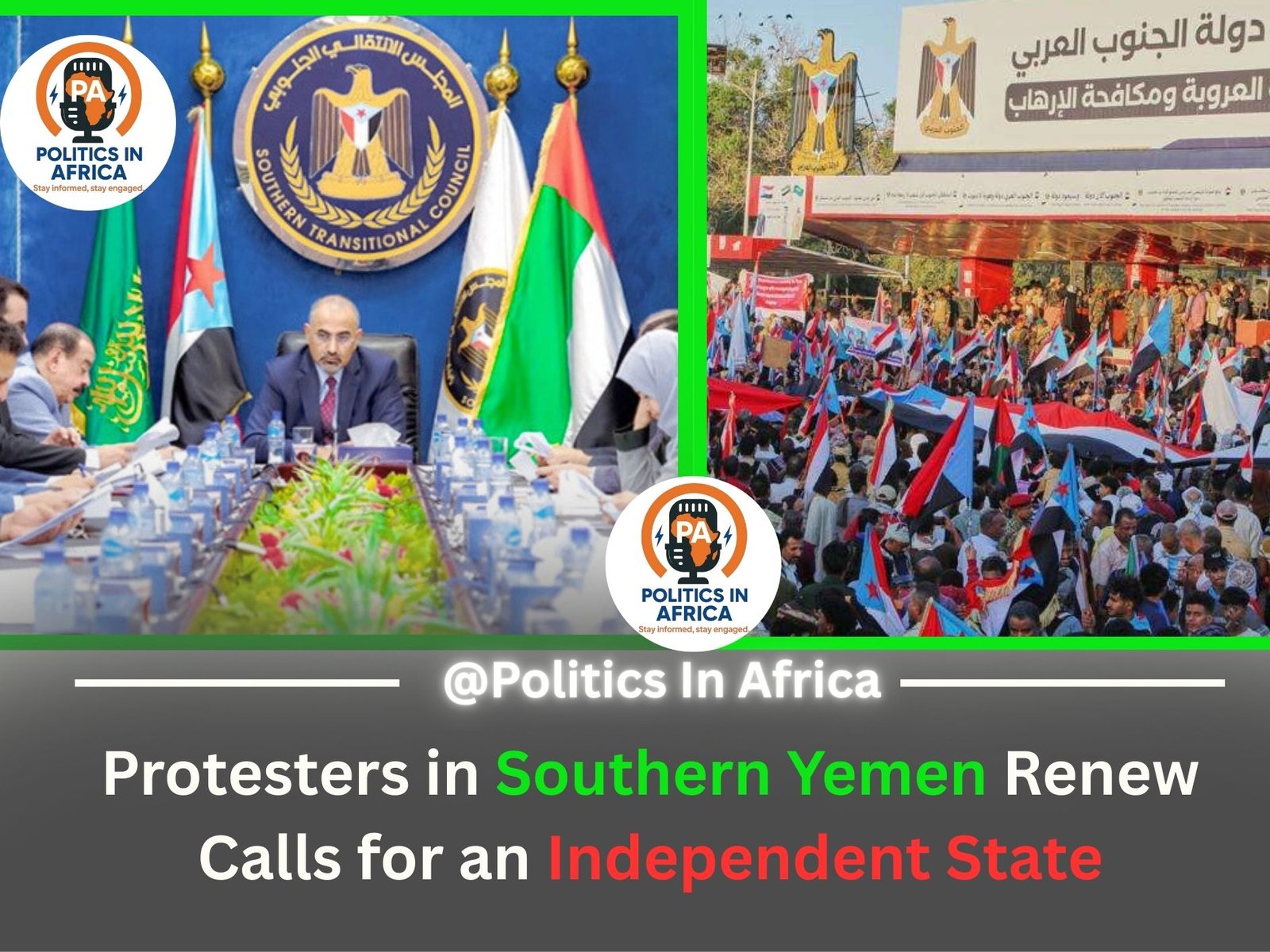
Polotics in Africa ,Adan Yemen. Large crowds gathered in southern Yemen on Friday to demand the restoration of an independent southern state, highlighting renewed momentum behind separatist ambitions despite recent political setbacks for the movement.

Demonstrators assembled in Aden’s Khor Maksar district, close to the international airport, waving the former South Yemen flag and chanting slogans in support of the Southern Transitional Council (STC) and its leader Aidarous al-Zubaidi. The rally followed similar protests held at the same location last weekend in Yemen’s interim capital.
Footage broadcast by the STC’s satellite channel showed thousands of protesters voicing opposition to Saudi Arabia while backing the STC’s declaration calling for a separate southern state. Some participants also carried posters of al-Zubaidi, who STC-linked media reports say left Aden for the United Arab Emirates earlier this month.
Roots of the separatist movement
Southern Yemen’s secessionist push is one layer of the wider conflict that has devastated the country since 2014, when Houthi forces seized the capital Sanaa, forcing the internationally recognized government to flee south and later into exile. The war has since drawn in regional and international actors, deepening political and humanitarian crises.
The STC was formed in 2017 as a coalition of southern groups seeking to revive South Yemen, which existed as an independent state from 1967 until unification in 1990. Support for the council has grown from long-standing grievances in the south, where many residents say they were politically and economically marginalized after unity.
Backed financially and militarily by the UAE, the STC later joined a Saudi-led alliance against the Houthis in 2022. However, tensions between Riyadh and Abu Dhabi became more visible late last year after STC forces advanced into Hadramout and al-Mahra, displacing Saudi-aligned units.
Protesters defend independence bid
Participants at Friday’s rally said independence would bring stability and economic control to the south. One protester said the demonstrations would continue until a southern state is restored, regardless of political pressure. Another argued that independence would improve living standards and allow southerners to manage their own oil and gas resources, which they believe are unfairly controlled by northern authorities.
Following the STC’s advances in December, Saudi-backed forces launched airstrikes and regained control of key areas, including the presidential palace in Aden. Soon after, the STC announced it would dissolve itself—an announcement that was publicly disputed by several of its members.
Political reshuffle and regional concerns
Amid the unrest, Yemen’s Saudi-backed Presidential Leadership Council replaced Prime Minister Salem bin Breik, appointing Foreign Minister Shae’a al-Zandani to form a new government. Council officials described the move as necessary to stabilize state institutions at a critical moment.
Saudi officials had previously welcomed the STC’s dissolution announcement, viewing its military activities near the kingdom’s border as a national security threat. Riyadh is now expected to host talks with influential southern figures, though no date has been confirmed.
Humanitarian situation worsens
Meanwhile, the humanitarian crisis continues to deepen. United Nations officials warned that more than half of Yemen’s population faces acute food insecurity in the coming weeks, with tens of thousands at risk of famine-like conditions. Funding shortages and access restrictions—particularly in Houthi-controlled areas—have severely limited aid delivery.
UN envoys stressed that Yemen’s political, economic, and security challenges are tightly linked, warning that progress in one area will not be sustainable without progress in the others.